Examples: Adding user-defined variables to default sets
A user-defined variable addition is a configuration action that
-
enables adding a variable, such as Var1, to a default set with a specific value (like 192.168.1.0/24),
-
allows customization of the variable value in any set, and
-
ensures that resetting the variable in the default set resets its default value to
anyacross all sets.
Set interactions and variable customization
The diagram below illustrates how adding and customizing user-defined variables affects default and custom sets.
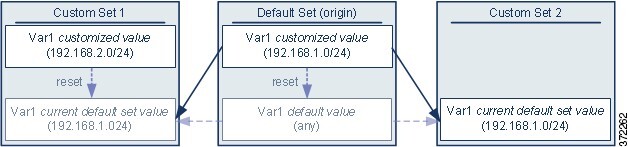
Customizing the value of Var1 in a custom set overrides the default value. For example, if Var1 is customized in Custom Set 1, it takes on a new value, while in Custom Set 2, if Var1 is not customized, it retains the default value (e.g., 192.168.1.0/24). Resetting the user-defined variable in the default set updates its default value to any in all sets.
Further, when Var1 in Custom Set 2 is not updated, customizing or resetting Var1 in the default set updates its current value in Custom Set 2, affecting any intrusion policy linked to the variable set.
Note | While the interactions are the same for user-defined variables and default variables, resetting a default variable in the default set resets it to the value configured by Cisco in the current rule update, not |
Customizing user-defined variable values
In Custom Set 1, the customized value 192.168.2.0/24 of Var1 overrides the default value, while in Custom Set 2, Var1 retains the default value 192.168.1.0/24 unless customized.
Resetting default variables in default sets
Although not shown in the example, note that interactions between sets are the same for user-defined variables and default variables except that resetting a default variable in the default set resets it to the value configured by Cisco in the current rule update.